
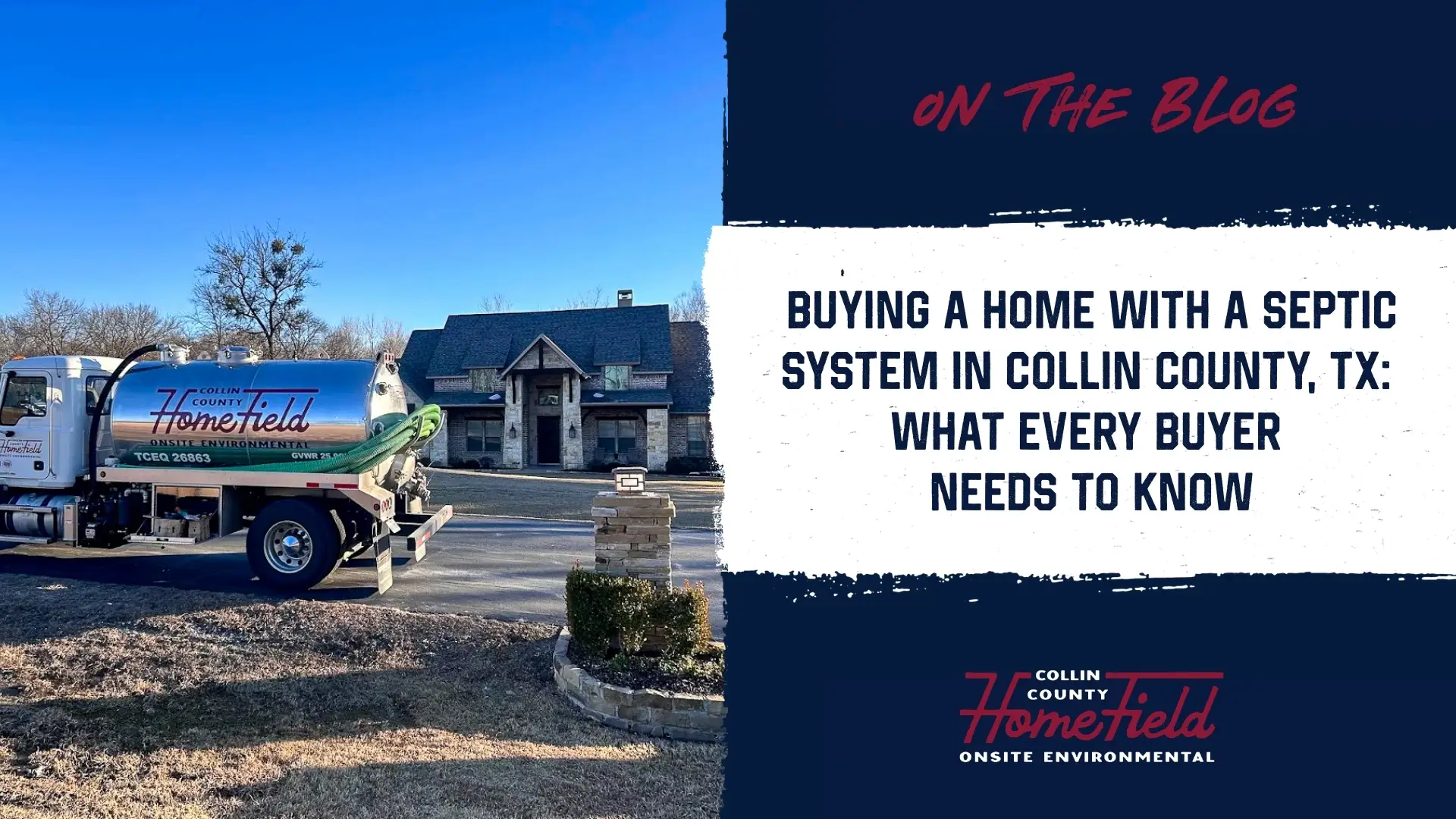
Buying a Home with Septic in Collin County, TX: What to Know
March 6, 2026
Quick Answer
Texas has no statewide mandate for septic inspections, but FHA, VA, and USDA loans all require one. Most conventional buyers get one anyway during the option period. Here in Collin County, with clay soils and aerobic systems everywhere, skipping it is a $10,000–$50,000 gamble.
📄 Want a quick reference you can keep? Download our free Septic Buyer’s Checklist (it’s a one-page summary of everything in this post).
The Inspection Question Nobody Asks Until It’s Too Late
You’re sitting in your realtor’s office, about to make an offer on that beautiful home in Frisco or McKinney. You’ve negotiated the price, the closing costs look fair, and everything feels right.
Then your realtor says: “Want to add an inspection contingency?”
You nod. Of course. That’s standard.
But here’s what most people don’t realize: that inspection contingency covers the house. Things like the roof, the foundation, the HVAC. It doesn’t cover the septic system. And in Collin County, that’s a mistake that can cost you tens of thousands of dollars.
Texas Has No Statewide Septic Inspection Requirement
Texas doesn’t mandate septic inspections for any type of home sale. You can buy a house with a septic system tomorrow and never have it inspected. Legally, you’re allowed to do that.
But here’s the catch: if you’re getting an FHA, VA, or USDA loan, that’s not your choice. HUD Handbook 4000.1 (FHA), VA Minimum Property Requirements, and USDA guidelines all require a septic inspection before loan approval. Your lender will demand it. Period.
If you’re buying with a conventional loan, the decision is yours. But the smart move is to get one anyway. You have 7–10 days during your option period. Use it.
What a Real Inspection Actually Costs and What It Covers
A real septic inspection costs $300–$600 here in Collin County. Not all inspections are created equal.
Your general home inspector can check that the tank is there and look for obvious red flags. But a real inspection requires a licensed septic professional with a pump truck. Here’s what they do:
- Visual inspection of the tank, access points, and drainfield
- Flow test (running water through the system to see how it handles volume)
- Tank access (opening it up to check for cracks, sludge, and scum levels)
- Dye test (flushing dye through the system to spot breaks in the distribution lines)
- Aerobic equipment check, if applicable: compressor, alarm, spray head condition
A general home inspector who doesn’t open the tank and run a dye test isn’t giving you the full picture. You need someone with a pump truck and a license. It costs more. But it saves you from buying a $400,000 house with a $40,000 septic problem hiding underneath.
Why Collin County Is Different from the Rest of Texas
Drive north from Dallas into Collin County, into Prosper, Celina, Allen, or the newer subdivisions around Plano, and you’ll notice something that doesn’t exist in Houston or San Antonio. Aerobic septic systems. Everywhere. It’s not a coincidence. It’s geology.
Blackland Prairie Clay: The Defining Soil Type
Here in Collin County, you’re sitting on the Blackland Prairie, which is roughly 60% clay. This clay makes it REALLY difficult for water to pass through it. That’s the problem.
The Texas Commission on Environmental Quality (TCEQ) classifies this as Type IV soil. Translation: conventional drain fields can’t be permitted here. You can’t just dig a hole in the ground and expect water to drain away.
So the builders and the county figured it out: use aerobic treatment. Aerate the wastewater first, then spray it on the ground. It works in clay. It’s the right solution for the soil you have.
But here’s what new buyers don’t always realize: aerobic systems cost more to own than conventional systems. If you don’t understand that before you close, you’ll be blindsided by the bills.
Red Flags That Kill Deals (vs. What You Can Negotiate)
Your septic inspection comes back with a list of issues. Now what? Some things are deal-breakers. Some things are negotiable. Here’s how to tell the difference.
Deal-Breakers: Don’t Close If You See These
A drainfield failure is a deal-breaker. You’ll see wet or soggy ground near the drainfield, smell septic odors in the yard, or find standing water. Replacement costs $10,000–$50,000. FHA and VA loans will not approve the sale.
A cracked tank is often a deal-breaker, though sometimes a skilled contractor can repair it. Check with your lender first…many won’t approve a home with a cracked tank without evidence of repair.
Total system failure (compressor dead, alarm buzzing for months, tank completely full) is the definition of a deal-breaker. This is why the inspection matters.
Negotiable Issues: Use the Inspection as Leverage
A cracked baffle (the interior wall inside the tank) can be fixed for $500–$2,000. Negotiate the seller to pay for it or credit you at closing.
“Never pumped” sounds bad, but it’s fixable. A pump runs $300–$600. Make the seller do it before closing.
Tree roots in the lines can be cleared for $500–$2,000. Not a system failure. Use it as a negotiating point.
A distribution box that’s out of level causes clogs. Repair cost is $500–$2,000. Negotiable.
No maintenance contract on an aerobic system is non-negotiable. The seller must provide an active contract or credit you. If you end up needing one post-closing, HomeField’s Advantage Plan has you covered.
The Math
A $10,000 repair often translates into a $15,000–$20,000 price reduction. Don’t settle for a handshake promise that the seller will fix it after closing. Get it in writing. Get it fixed before you take over. This is why the inspection isn’t a cost — it’s insurance.
Aerobic Systems: What Collin County Buyers Must Know
If you’re buying here in Collin County, there’s a decent chance your home has an aerobic septic system. It’s the right choice for our soil. But it’s different from what most buyers expect, and there are rules.
How an Aerobic System Works
An aerobic system has four main components: a septic tank (where solids settle), an aerated treatment unit (where air gets pumped in to treat the wastewater), a pump chamber (to push treated water to the drainfield), and spray heads or a drip field (where treated water gets distributed). The aeration step breaks down solids and reduces pathogens so the treated water is safe to spray on the ground. It works in clay. That’s why it’s everywhere in Collin County.
Cost to Install and Cost to Own
Installation runs $12,000–$26,000 for an aerobic system, compared to $10,000–$15,000 for conventional. That’s $5,000–$11,000 more upfront. The real cost is ongoing: every aerobic system in Collin County must have a maintenance contract with a minimum of three professional inspections per year. That contract runs $400–$600 annually, plus chlorine tablets and monthly monitoring.
At Closing: Three Forms You Need to Know
When you buy a home with an aerobic system in Collin County, the title transfer triggers county rules. You can’t inherit the seller’s maintenance contract. Instead, you have to execute three forms:
- Change of Ownership: Notifies Collin County Development Services that the system has a new owner
- Aerobic Homeowner’s Information Sheet: Your proof of ownership and contact info for the county
- New Maintenance Contract: In your name, with your chosen service provider
Collin County requires these to be submitted within 15 days of closing through the county’s OSSF Report Portal. Don’t let that window slip.
Red Flags Specific to Aerobic Systems
When reviewing the inspection report and disclosures, watch for these:
- No current maintenance contract (you’ll be forced to get one immediately)
- Missing inspection reports from the last year or two (sign of neglected maintenance)
- A dead or missing chlorine dispenser (simple fix, but a sign of neglect)
- An alarm that’s been buzzing for months (the system is asking for help)
- A compressor that won’t turn on (expensive repair)
HomeField’s Advantage Plan covers all three required annual inspections plus county reporting, so you’re always compliant and never get a surprise from Collin County Development Services.
What Texas Law Requires Sellers to Tell You
Before you buy a home in Collin County with a septic system, the seller has legal disclosure obligations. These forms won’t protect you if you don’t read them carefully.
The Seller’s Disclosure Notice (TXR-1406)
Form TXR-1406 is the standard Seller’s Disclosure Notice in Texas. It includes a checkbox for “on-site sewer facility.” The seller checks it if there’s a septic system. That’s the beginning of the story.
The On-Site Sewer Facility Form (TXR-1407)
If the seller checks that box, they’re supposed to provide Form TXR-1407: Information About On-Site Sewer Facility. This form covers system type, age, condition, maintenance history, any repairs or failures, and whether there’s an active maintenance contract. This is where the real information lives. If the seller says “no known issues” but has zero maintenance records going back five years, that’s a red flag.
“As-Is” Doesn’t Override Disclosure
A common misconception: if you buy a house “as-is,” the seller doesn’t have to disclose septic issues. That’s wrong. Texas Property Code § 5.008 is clear — “as-is” doesn’t eliminate the seller’s obligation to disclose known defects. If the seller knows the system failed last year and doesn’t tell you, that’s a breach of disclosure law, even in an as-is sale. This is why the inspection matters. It gives you independent verification of what the seller told you (or didn’t).
Questions to Ask Before You Close
Before you sign the final paperwork, get answers to these questions in writing. If the seller won’t answer, that tells you something.
- What type of system is it, and how old?
- When was it last pumped? Do you have records?
- Has it ever failed or been repaired?
- Is there a current maintenance contract (if aerobic)?
- Can I see the last three inspection reports (if aerobic)?
- Where is the tank, and how easy is it to access?
A seller who refuses to answer is usually hiding something.
Your First 30 Days as a Septic Owner in Collin County
You’ve closed. The house is yours. Now what?
Notify Collin County Development Services. If your home has an aerobic system, the county needs to know you’re the new owner. This usually happens through the maintenance contract signed at closing, but call to confirm they have you on file.
Execute your maintenance contract and submit your forms. The three county forms must be submitted to Collin County’s OSSF Report Portal within 15 days of closing. Don’t put it off. HomeField can get this set up for you.
Schedule a baseline inspection. Whether you have an aerobic or conventional system, get a licensed professional out in your first 30 days. Not sure how often to pump or what warning signs to watch for? We’ve got those covered too.
Find your tank. Your closing documents might show the location. If not, ask your builder, your agent, or call us. Knowing where it is saves you money if you ever need service.
Learn what not to flush. No wipes (even the ones labeled “flushable”), no grease, no harsh chemicals, no feminine hygiene products. These things cause more septic problems than anything else.
If you have an aerobic system and want the required inspections and county reporting handled for you, the Advantage Plan takes care of all of it.
FAQ
Is a septic inspection required when buying a house in Texas?
Texas has no statewide requirement. But FHA, VA, and USDA loans all require one before closing. If you’re using a conventional loan, it’s not mandated, but it’s the smart move. Your option period (typically 7–10 days) is the window to get it done.
How much does a septic inspection cost in Collin County?
A thorough inspection with a licensed professional and a pump truck runs $300–$600. That’s a bargain compared to discovering a $30,000 drainfield failure after closing.
What happens if the septic inspection fails?
It depends on the failure. A cracked baffle is negotiable (seller pays or credits you). A drainfield failure is a deal-breaker and likely kills the sale or requires major price negotiation. Use the results to negotiate repairs, credits, or a price reduction before you close.
What is an aerobic septic system and why does Collin County have so many of them?
An aerobic system treats wastewater using pumped air before distributing it on the ground. Here in Collin County, Blackland Prairie clay soils don’t drain well enough for conventional systems, so aerobic is what the TCEQ approves for our soil type. It works in clay. That’s why you see it everywhere in newer Collin County construction.
Do I have to get a maintenance contract for an aerobic septic system?
Yes. Collin County requires a maintenance contract with a minimum of three professional inspections per year. This is not optional. It costs $400–$600 annually and must be in the new owner’s name, with forms submitted to the county’s OSSF Report Portal within 15 days of closing.
What’s the difference between TXR-1406 and TXR-1407?
TXR-1406 is the Seller’s Disclosure Notice where the seller indicates a septic system exists. TXR-1407 is the separate form covering system type, age, condition, and maintenance history. You should receive both. If you only get TXR-1406 with a checkbox, ask for TXR-1407 before you proceed.
Ready to Buy with Confidence
Buying a home with a septic system in Collin County doesn’t have to be scary. But it does require knowing what you’re looking at.
Get a real inspection. Ask the right questions. Use the results to negotiate. And if you end up with an aerobic system, get your maintenance contract executed before that 15-day window closes.
If you need a pre-purchase septic inspection, we can schedule one at our septic inspection page. If you’ve just closed on a home with an aerobic system and need to get compliant fast, call us. We’ll get you set up.
Welcome to Collin County homeownership.
Written by the HomeField Collin County Team. HomeField is a licensed OSSF service provider operating under TCEQ regulations in Collin County, Texas. Last reviewed: March 6, 2026.
Sources
- U.S. EPA — Septic Systems
- Texas Commission on Environmental Quality — OSSF Guidance
- Collin County Court Order No. 2008-187-03-11 — OSSF Rules and Regulations
- Collin County Development Services — On-Site Sewage Facilities
- Texas REALTORS — Forms TXR-1406 and TXR-1407
- Texas Property Code § 5.008 — Seller’s Disclosure Requirements

Collin County Team
We're the home team of HomeField Collin County, and we're here to share our best septic tips, tricks, and knowledge about service in this area.
Other Top Posts:
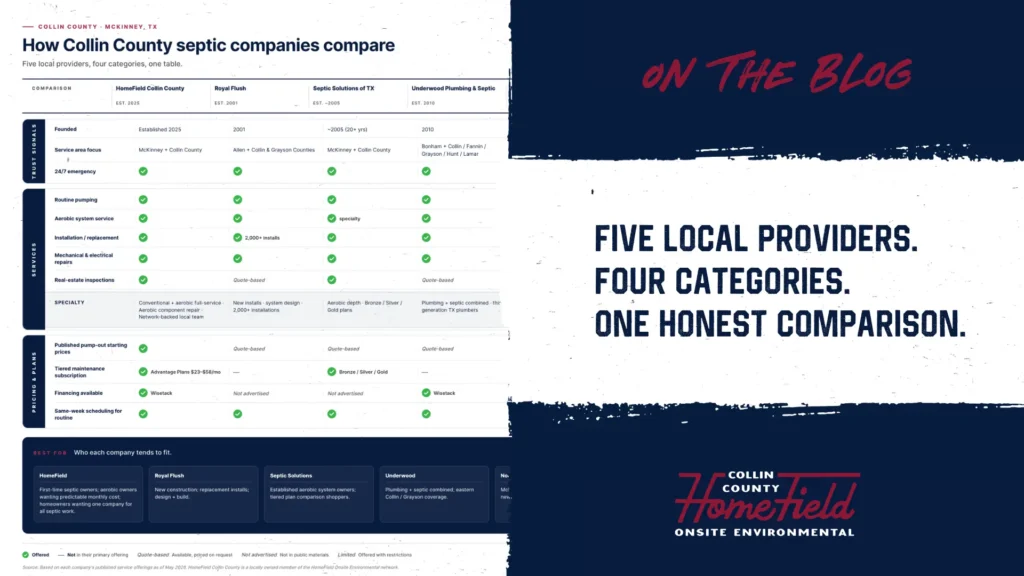
Best Septic Pumping Companies in McKinney, TX (2026)
Last updated: May 2026 · Next scheduled refresh: August 2026 If you’re…
Buying a Home with Septic in Collin County, TX: What to Know
Quick Answer Texas has no statewide mandate for septic inspections, but FHA,…
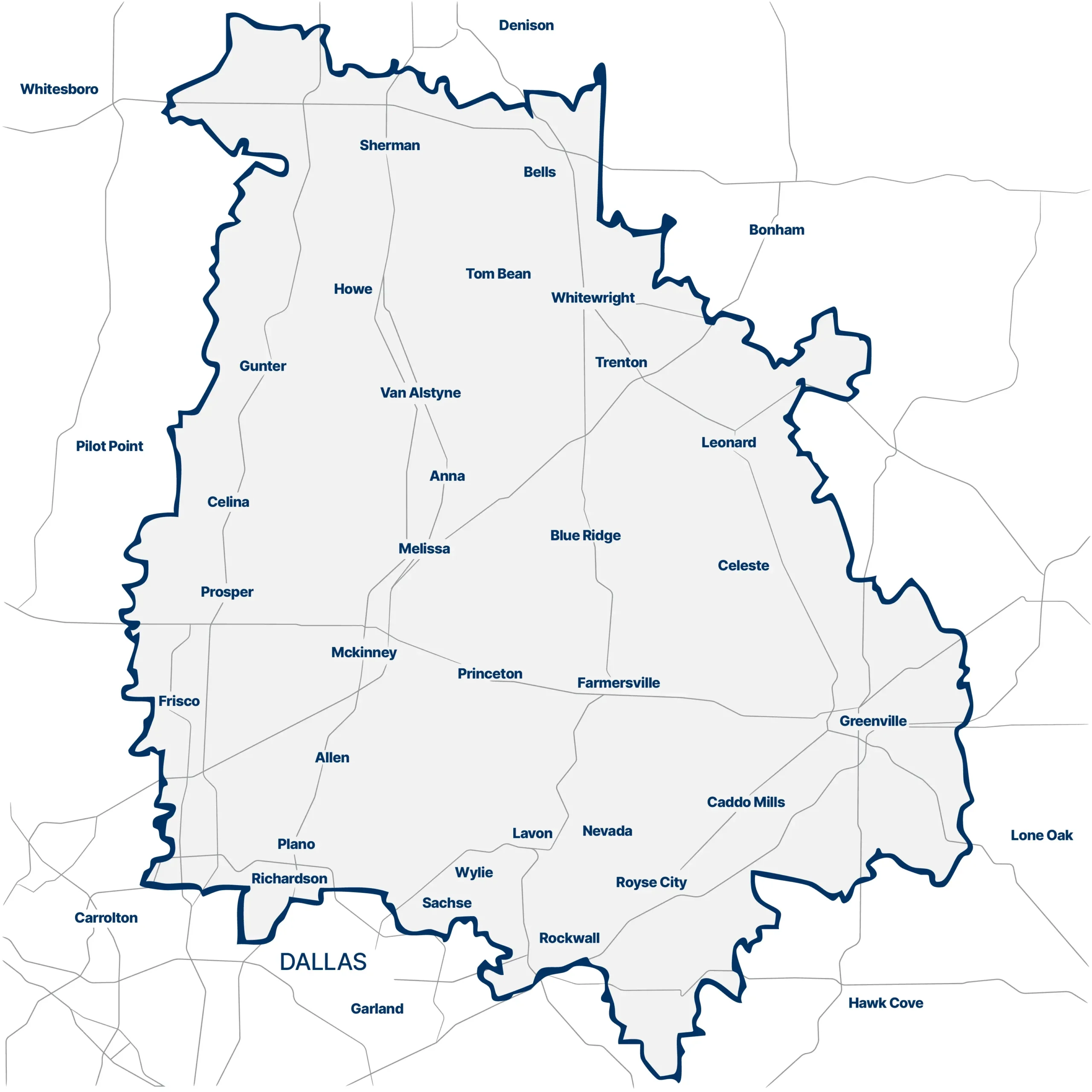
OUR SERVICE AREA
WE LOVE OURHOME TURF
We proudly serve the cities and towns in our home turf of Collin County, including: